
Chicory Leaf Palla Rossa Precoce (Bag) – Franchi Sementi
$2.00
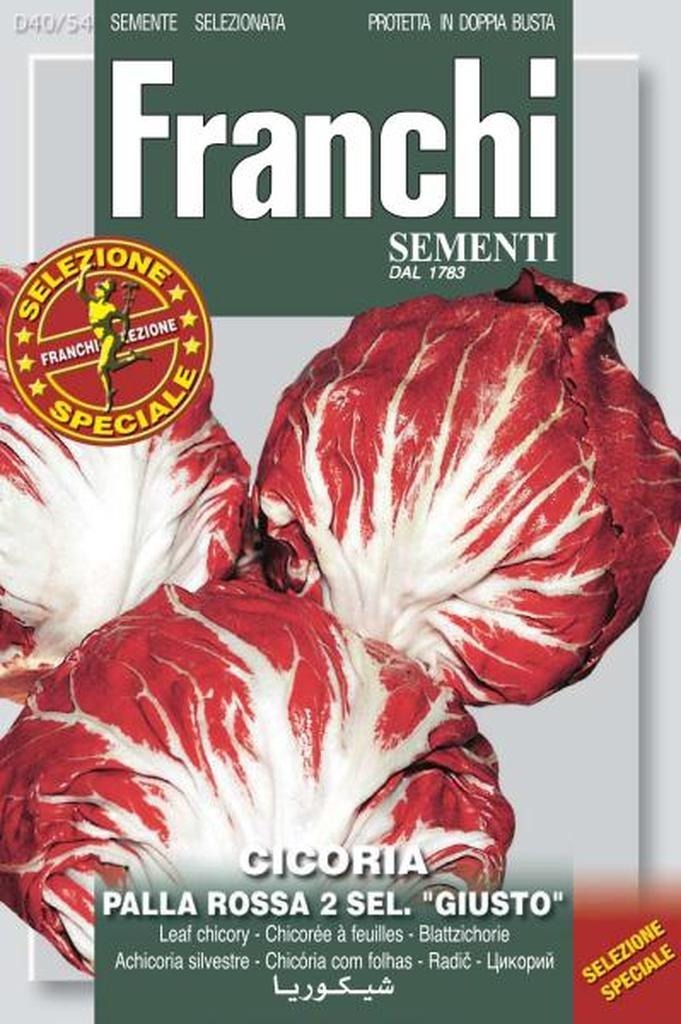
Radicchio Palla Rossa 3 has probably the greatest color contrast of the red radicchios. It is fairly easy to grow in that it consistently forms nice heads. Nice taste and texture. 75-80 days. Best in fall. Most intense color in late fall during cool weather. Sometimes need to be ‘forced’. Grow like Radicchio di Chioggia. 7 gram packet.
Days to maturity: 90 – 100
R12 – Classic Palla Rossa Radicchio. Compact tight redhead. RHS Award of Garden Merit winner.
Seeds quantity: @6000 seeds.
Sow: from May-Aug
Harvest: Aug-Nov.
Partnership plant: Carrot, Bean, Fennel, Lettuce, Pepper,
Tomato.
What to sow after: Cauliflower, Cabbage, Cucumber, Bean,
Aubergine, Melon, Pepper, Pea, Tomato, Radish, Courgette.
1g
Radicchio Palla Rossa 3 has probably the greatest color contrast of the red radicchios. It is fairly easy to grow in that it consistently forms nice heads. Nice taste and texture. 75-80 days. Best in fall. Most intense color in late fall during cool weather. Sometimes need to be ‘forced’. Grow like Radicchio di Chioggia. 7 gram packet.
Days to maturity: 90 – 100
R12 – Classic Palla Rossa Radicchio. Compact tight redhead. RHS Award of Garden Merit winner.
Seeds quantity: @6000 seeds.
Sow: from May-Aug
Harvest: Aug-Nov.
Partnership plant: Carrot, Bean, Fennel, Lettuce, Pepper,
Tomato.
What to sow after: Cauliflower, Cabbage, Cucumber, Bean,
Aubergine, Melon, Pepper, Pea, Tomato, Radish, Courgette.
1g
Related products
Cauliflower Verona Tardivo (Bag) – Franchi Sementi
*Heritage Variety*
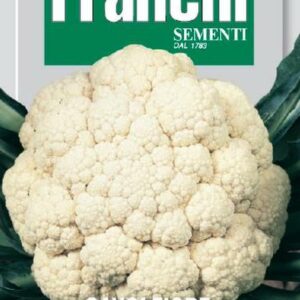
V25 - Cream coloured head of good dimensions and good resistance to cold. This variety is only found in and around Verona.
Approximately 80 days to maturity
Approximate seeds quantity:@6000
Sow: from May - end July and harvest February - April
Partnership plant: Chard, Cucumber, Bean, Lettuce, Pepper, Pea,
Tomato, Leek, Spinach.
What to sow after: Chicory, Bean, Endive, Lettuce, Pea, Leek,
Spinach, Lamb's lettuce.
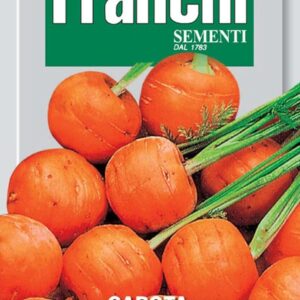
Carrot Parisier Markt (Daucus Carota) (Bag) – Franchi Sementi
Carrot Pariser Market 4. Small, round specialty type carrot. Tender and crunchy. Really pretty carrot and very popular in French markets. Children love these little round carrots as well. Does well anywhere, but really good and quick with heavy clay soil. Fairly early. 6 gram pack. Approximately 400-1200 seeds per gram.
This variety is on the Slow Food Ark of Taste which means it is endangered. By using Franchi seeds you are supporting BioDiversity. https://www.fondazioneslowfood.com/en/ark-of-taste-slow-food/paris-round-carrot/
V18 - Featured on BBC Gardeners World 20/04/07. Round French Parisian carrots with good flavour. It's a classic case of the carrot changing to suit it's environment, and is basically a clay carrot. Easy to grow in containers and not as prone to carrot root fly. Sow in the Spring as you can get quite a late sowing. Also great to use in Indoor Farming systems and for Urban gardening in containers.The carrot (Daucus carota) is also called “Pastenade”, probably arrived on French tables in the 14th century, but at the outset it had little in common with the carrot we know today, since it was white, tenderer and mostly more fibrous. It took until the 18th and the middle of the 19th century for the orange varieties – coming from Afghanistan – to be more and more appreciated, probably for its tenderness. In the beginning it was known as a “lower class” vegetable, reserved for the common people, historically a very consumed vegetable, and still the second most eaten vegetable in France today. The Paris market carrot is a small round one (2-4cm in diameter) of the Grelot type that is sought after for its tenderness and sweetness. It is a very early carrot, fast-growing and preserves well; it can be sown all year round, and especially in spring and end of summer. This variety grows on the surface of the soil, and it also prefers sandy to clayey but not compact soil. Some people attribute a honey flavour to it; when used in the kitchen, it is often prized in part for what sets it apart: its unconventional shape. Carrots are inseparable from the popular stew, beef-carrots and also Vichy carrots, created in the 16th and 17th centuries and cooked in Vichy thermal water. Like all ancient vegetable varieties, the Paris round carrot has a low yield, a surprising aspect that can make it difficult to use. Thus it has been replaced by more productive hybrids that often have no heart (or at least a very thin one) like the Nantes or Touchon varieties. There are not many market farmers who grow it. One of them, Laurent Berrurier, tells us he grows on average 500 bunches per year (about 450 kilos).
Approximate seeds quantity:@7000
Sow: from February - July
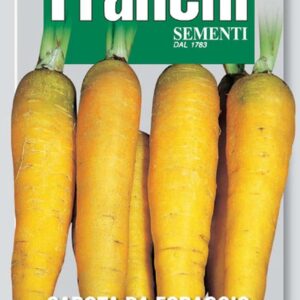
Carrot Jaune du Doubs (Daucus Carota) (Bag) – Franchi Sementi
Yellow carrot from Doubs. An old heirloom variety from France, but grown in Italy. 80+ days. Long, conical root (6-12 inches) with very little central core. Excellent taste; very sweet. Appears to have some resistance to carrot fly. 6 gram packet. Approximately 400-1200 seeds per gram.
V82 - Rustic yellow carrot variety from the beautiful French town of Doubs. Once used just for forage, but now prized for it's culinary quality.
Approximate seeds quantity:@4000
Sow: from February - July
Partnership plant: Chard, Chicory, Lettuce, Pea, Tomato,
Leek, Radish, Spinach.
What to sow after: Cucumber, Chicory, Bean, Endive, Lettuce,
Melon, Pea, Radish, Courgette.
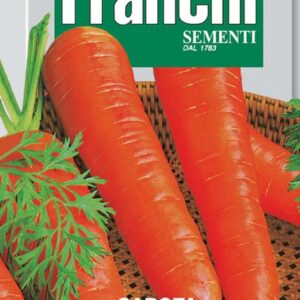
Carrot Flakkee Gigante (Daucus Carota) (Bag) – Franchi Sementi
Carrot Flakkee 2. Conical shape which does well in heavy soil. Excellent taste. Very crisp & tender. An all-around great carrot. 8 gram packet. Approximately 400-1200 seeds per gram.
V88 - Late variety that produces large, long carrots. This popular variety is also known as a Flak carrot. The root has an bright orange flash with lighter core.
This carrot can be grown in heavy soil.
Approximate seeds quantity:@7000
Sow: from March - July
Partnership plant: Chard, Chicory, Lettuce, Pea, Tomato,
Leek, Radish, Spinach.
What to sow after: Cucumber, Chicory, Bean, Endive, Lettuce,
Melon, Pea, Radish, Courgette.
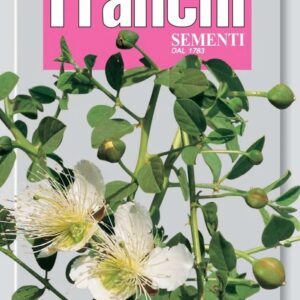
Capers (Bag) – Franchi Sementi
Capers/Cappero. Mature caper bushes can grow three feet high and spread four or five feet. They are quite pretty and aromatic. They require dry heat and intense sunlight to flourish. Will be killed by temperatures below 20 degrees F. In the north, bring them inside in the winter and treat them like rosemary. Seeds are sometimes difficult to germinate; soak seeds a day, put in refridgerator in wet towel in plastic bag for 6 weeks, then plant in 5" pots, 4 seeds/pot. Thin to strongest. When transplanting, disturb root as little as possible. May have flowers year 1, will have them year 2. 1 gram packet.
Indoor only. This perennial plant is ideal for pickling in vinegar for later use on pizza and in antipasti. Must be grown in a hot climate, or in a greenhouse/conservatory. Sow from Mar-Jun and add sand and gravel to the soil. Please note that germination can take from 3-12 months.
Capers/Cappero. Mature caper bushes can grow three feet high and spread four or five feet. They are quite pretty and aromatic. They require dry heat and intense sunlight to flourish. Will be killed by temperatures below 20 degrees F. In the UK, bring them inside in the winter and treat them like rosemary. Seeds are sometimes difficult to germinate; soak seeds a day, put in refrigerator in wet towel in plastic bag for 6 weeks, then plant in 5" pots, 4 seeds/pot. Thin to strongest. When transplanting, disturb root as little as possible. May have flowers year 1, will have them year 2. 1 gram packet. To learn more about growing capers, click here.
Approximate seeds quantity:@120
Sow: Spring
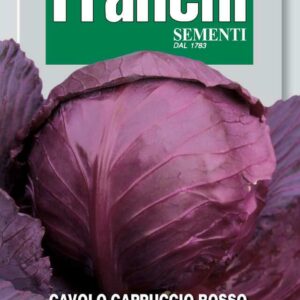
Cabbage Red Tete Noire (Bag) – Franchi Sementi
Cabeza Negra. Also known as Cavolo Cappuccio. (Red Cabbage). Solid red smooth leaf cabbage. Large head, good taste. 85 days. Best color if planted for fall harvest. 6 gram packet, approx. 1200 seeds. Approximately 190-300 seeds per gram.
V57 - Frost resistant. Firm, deep red. A Christmas favourite braised sweet and sour.
Approximate seeds quantity:@1500
Sow: from May - end July
Partnership plant: Chard, Cucumber, Bean, Lettuce, Pepper, Pea,
Tomato, Leek, Spinach.
What to sow after: Chicory, Bean, Endive, Lettuce, Pea, Leek,
Spinach, Lamb's lettuce.
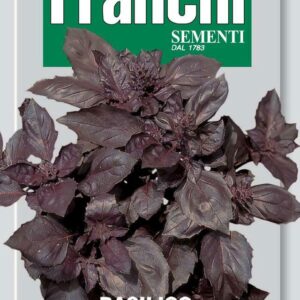
Basil Violetto Aromatico / Dark Opal (Ocimum basilicum L.) (Bag) – Franchi Sementi
Violetto Aromatico / Dark Opal basil. This is a really pretty basil. Nice color, good size plant similar in size and growth habit to Genovese basil. Good aroma and flavor. Will do ok in a pot, but does better outside in the garden. Consider using it as a decorative plant in place of flowers. A bed of red basil, Genovese basil and lettuce leaf basil is quite pretty. For transplants, start 6-7 weeks before set out date (10 days after last frost date), 5-6 seeds/cell and thin to two or three. Plant at 12 inch intervals. For direct seed, 6-7 seeds every 12 inches cover with 1/4 inch fine soil and keep watered until germination: 7-10 days. Thin to 2-3 plants per space.
Basil has approximately 600-650 seeds per gram.
*Heritage Variety*
Red Basil. This is a mid-early variety with vigorus plant. The leaves have a bright violet colour and a sweet intense perfume. Sweeter tasting than regular basil with a slight clove undertone.
Easy to grow and ideal for containers.
Approximate seeds quantity: @3200 seeds.
To be sown from March to July directly in the ground or all year long in a protected indoor system.