
1g
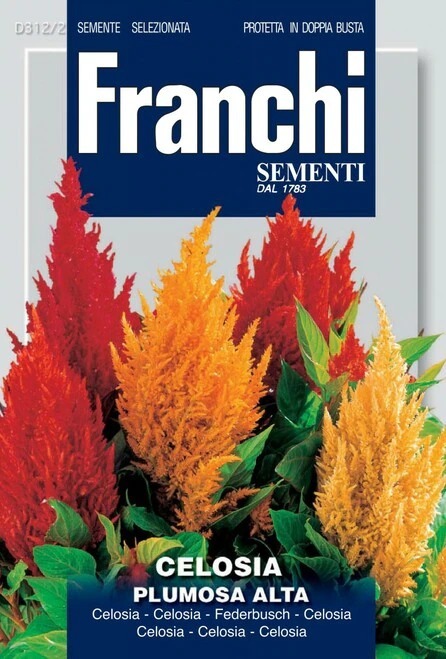
Celosia plumosa (Bag) – Franchi Sementi
$2.00
1g
14
People watching this product now!
Description
Additional information
| Brands |
Franchi Sementi |
|---|
Related products
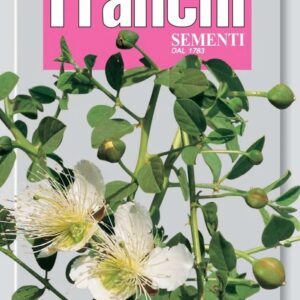
Capers (Bag) – Franchi Sementi
Capers/Cappero. Mature caper bushes can grow three feet high and spread four or five feet. They are quite pretty and aromatic. They require dry heat and intense sunlight to flourish. Will be killed by temperatures below 20 degrees F. In the north, bring them inside in the winter and treat them like rosemary. Seeds are sometimes difficult to germinate; soak seeds a day, put in refridgerator in wet towel in plastic bag for 6 weeks, then plant in 5" pots, 4 seeds/pot. Thin to strongest. When transplanting, disturb root as little as possible. May have flowers year 1, will have them year 2. 1 gram packet.
Indoor only. This perennial plant is ideal for pickling in vinegar for later use on pizza and in antipasti. Must be grown in a hot climate, or in a greenhouse/conservatory. Sow from Mar-Jun and add sand and gravel to the soil. Please note that germination can take from 3-12 months.
Capers/Cappero. Mature caper bushes can grow three feet high and spread four or five feet. They are quite pretty and aromatic. They require dry heat and intense sunlight to flourish. Will be killed by temperatures below 20 degrees F. In the UK, bring them inside in the winter and treat them like rosemary. Seeds are sometimes difficult to germinate; soak seeds a day, put in refrigerator in wet towel in plastic bag for 6 weeks, then plant in 5" pots, 4 seeds/pot. Thin to strongest. When transplanting, disturb root as little as possible. May have flowers year 1, will have them year 2. 1 gram packet. To learn more about growing capers, click here.
Approximate seeds quantity:@120
Sow: Spring
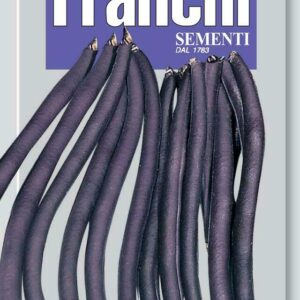
Bean Dwarf Purple King (Phaseolus vulgaris L.) (Bag) – Franchi Sementi
B13 - Early variety of dwarf Purple French bean which turns green when cooked. The plants are about 50cm tall, vigorous. Pods are stringless and meaty.
Weight: 45g
Sow: from April - mid July
Pods: 15cms long
Partnership plant: Chard, Cauliflower, Cabbage, Cucumber,
Chicory and Radicchio, Lettuce, Aubergine, Radish, Corn.
What to sow after: Chard, Carrots, Cauliflower, Cabbage,
Cucumber, Chicory and Radicchio, Fennel, Endive,
Lettuce, Aubergine,Melon, Pepper, Tomato, Leek,
Parsley, Radish, Spinach, Lamb's lettuce, Courgette.
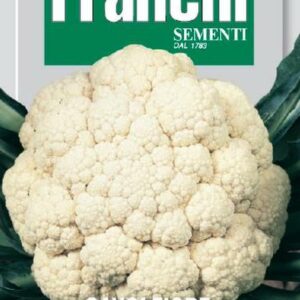
Cauliflower Verona Tardivo (Bag) – Franchi Sementi
*Heritage Variety*
V25 - Cream coloured head of good dimensions and good resistance to cold. This variety is only found in and around Verona.
Approximately 80 days to maturity
Approximate seeds quantity:@6000
Sow: from May - end July and harvest February - April
Partnership plant: Chard, Cucumber, Bean, Lettuce, Pepper, Pea,
Tomato, Leek, Spinach.
What to sow after: Chicory, Bean, Endive, Lettuce, Pea, Leek,
Spinach, Lamb's lettuce.
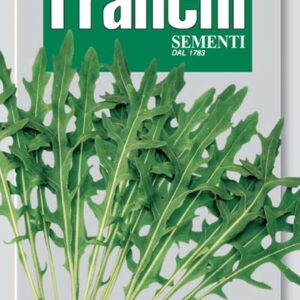
Arugula Selvatica or Wild Rocket (Diplotaxis tenuifollia)(Bag) – Franchi Sementi
Arugula Selvatica means Wild Arugula. Compared to Cultivated Arugula, it is slower growing, ready in about 50 days, with more deeply lobed leaves and a more pungent flavor. This is the type of Arugula (also called Rucola or Rocket) that grows wild in the countryside around Rome. Seeds of Arugula selvatica are much smaller than Arugula Coltivata seeds, so the packet weight is smaller but still contains a similar number of seeds. Arugula selvatica has 3,000 seeds per gram. Our 3-gram packet is about 9,000 seeds.
Arugula has been grown since Roman times, reputedly as an aphrodisiac, and is used widely in Italian cuisine. It's great as a salad ingredient, or simply eaten alone with a sprinkle of salt and a drizzle of olive oil. In Italy, it is often wilted over hot pizza or in pasta just before serving. Ischia, an island in the Bay of Naples, has a traditional digestif liqueur made from arugula, called rucolino. Arugula pesto is made just like basil pesto, and is a good substitute when the weather is too cold for basil. Arugula survives low temperatures and is usually the first and last salad green in the garden. Under row cover, it will survive all but the coldest winters.
Sprinkle seeds about an inch apart. Replant frequently for a long season of harvest. Our huge packets provide plenty of seed!
1g
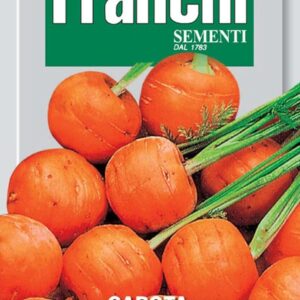
Carrot Parisier Markt (Daucus Carota) (Bag) – Franchi Sementi
Carrot Pariser Market 4. Small, round specialty type carrot. Tender and crunchy. Really pretty carrot and very popular in French markets. Children love these little round carrots as well. Does well anywhere, but really good and quick with heavy clay soil. Fairly early. 6 gram pack. Approximately 400-1200 seeds per gram.
This variety is on the Slow Food Ark of Taste which means it is endangered. By using Franchi seeds you are supporting BioDiversity. https://www.fondazioneslowfood.com/en/ark-of-taste-slow-food/paris-round-carrot/
V18 - Featured on BBC Gardeners World 20/04/07. Round French Parisian carrots with good flavour. It's a classic case of the carrot changing to suit it's environment, and is basically a clay carrot. Easy to grow in containers and not as prone to carrot root fly. Sow in the Spring as you can get quite a late sowing. Also great to use in Indoor Farming systems and for Urban gardening in containers.The carrot (Daucus carota) is also called “Pastenade”, probably arrived on French tables in the 14th century, but at the outset it had little in common with the carrot we know today, since it was white, tenderer and mostly more fibrous. It took until the 18th and the middle of the 19th century for the orange varieties – coming from Afghanistan – to be more and more appreciated, probably for its tenderness. In the beginning it was known as a “lower class” vegetable, reserved for the common people, historically a very consumed vegetable, and still the second most eaten vegetable in France today. The Paris market carrot is a small round one (2-4cm in diameter) of the Grelot type that is sought after for its tenderness and sweetness. It is a very early carrot, fast-growing and preserves well; it can be sown all year round, and especially in spring and end of summer. This variety grows on the surface of the soil, and it also prefers sandy to clayey but not compact soil. Some people attribute a honey flavour to it; when used in the kitchen, it is often prized in part for what sets it apart: its unconventional shape. Carrots are inseparable from the popular stew, beef-carrots and also Vichy carrots, created in the 16th and 17th centuries and cooked in Vichy thermal water. Like all ancient vegetable varieties, the Paris round carrot has a low yield, a surprising aspect that can make it difficult to use. Thus it has been replaced by more productive hybrids that often have no heart (or at least a very thin one) like the Nantes or Touchon varieties. There are not many market farmers who grow it. One of them, Laurent Berrurier, tells us he grows on average 500 bunches per year (about 450 kilos).
Approximate seeds quantity:@7000
Sow: from February - July